In March, Starbucks handed 35 million Americans a rank. The tiers are real, the perks at the top are extraordinary, and the earning rate quietly went down for nearly everyone. Here is what your Stars are actually worth — and the benefit hiding in the last line of the announcement.
On March 10, 2026, Starbucks relaunched its rewards program with three membership levels: Green, Gold, and Reserve.
It was the first time since 2019 that a Starbucks account came with a rank attached. For seven years, every member had been treated identically. Now your level is set by how many Stars you earn across a rolling twelve months, and that level determines how fast you earn everything after it.
The announcement was warm and member-forward. Global chief brand officer Tressie Lieberman called it a key milestone in the company’s Back to Starbucks strategy, built to “ignite fandom.”
Here is how the three tiers work.
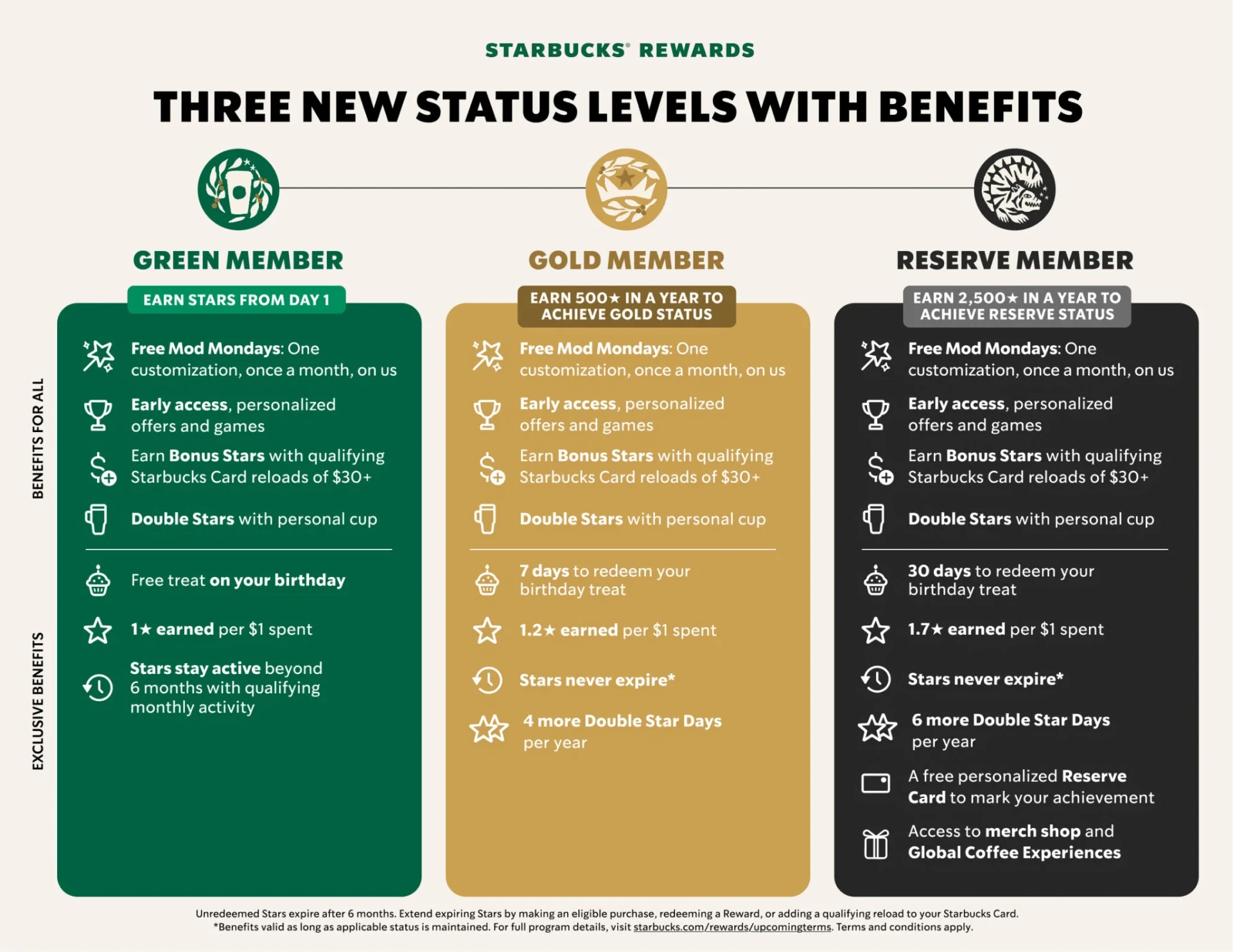
Green is where everyone starts. You earn one Star per dollar.
Gold arrives once you’ve earned 500 Stars in a twelve-month period. The rate rises to 1.2 Stars per dollar, you get at least four extra Double Star Days, a seven-day window for your birthday reward, and — the change members had been asking for most — Stars that no longer expire.
Reserve requires 2,500 Stars in twelve months. You earn 1.7 Stars per dollar, get six or more extra Double Star Days, a thirty-day birthday window, exclusive merchandise and events, and all-expenses-paid trips to Tokyo, Milan, or Costa Rica to see coffee at its source.
| Tier | Threshold (rolling 12 mo.) | Earn rate | Star expiration | Birthday window |
|---|---|---|---|---|
| Green | Automatic | 1.0 ★ / $1 | 6 months, extendable monthly | Day of |
| Gold | 500 Stars | 1.2 ★ / $1 | Never | 7 days |
| Reserve | 2,500 Stars | 1.7 ★ / $1 | Never | 30 days |
Status lasts twelve months. To keep it, you have to earn the same number of Stars again the following year.
Nobody started from zero, either. When the program launched, Starbucks assigned everyone a tier based on the Stars they’d earned between January and December of 2025, and every existing Star stayed in the account. Millions of people opened the app in March and found they’d already been promoted.
That’s the announcement. Now the part that didn’t make the headlines.
Almost Everyone Is Earning Less
In its own materials, Starbucks described the redesign as moving away from a system where Star-earning was “tied solely to payment type.”
That phrase is worth slowing down on.
The payment type in question was the preloaded Starbucks Card. If you loaded money onto it first and paid with that balance, you earned two Stars per dollar — double the rate of paying with a credit card at the counter. It was the reason the app’s prepay habit existed.
That two-Star rate is gone.
So the real comparison isn’t Green versus Gold. It’s every new tier measured against what a preloading member used to get.
Green earns 1.0. That’s half. Gold earns 1.2. That’s a 40% cut. And Reserve — the top tier, the one that costs roughly $2,000 to $2,500 a year and sends you to Milan — earns 1.7. Still less than a once-a-month customer collected in 2025 by remembering to load a gift card first.
Starbucks did add bonus Stars for reloading, but they don’t close the gap. You now get 10 Stars for a digital reload of $30 or more, and 25 Stars for $50 or more.
Run the numbers on a $50 reload at Gold:
- Reload $50 → 25 bonus Stars
- Spend that $50 at 1.2 Stars per dollar → 60 Stars
- Total: 85 Stars
Under the old program, that same $50 earned a flat 100 Stars just for loading it.
The tiers are real. The status is real. The earning is down.
One piece of fine print does run in your favor, and it gets almost no coverage. Green Stars expire after six months — but any single activity in a month extends them another month. A purchase counts. A redemption counts. A digital reload counts. The clock is much easier to hold off than the six-month rule makes it sound.
What a Star Is Actually Worth
Starbucks also put hard dollar caps on every redemption level, and those caps are what determine whether any of this is worth thinking about.
There are six levels now:
- 25 Stars — a drink customization, up to $1
- 60 Stars — $2 off any purchase (new)
- 100 Stars — brewed coffee, tea, bakery item or packaged snack, up to $6
- 200 Stars — any handcrafted drink or hot breakfast, up to $10
- 300 Stars — sandwich, protein box or packaged coffee, up to $16
- 400 Stars — select merchandise, up to $20
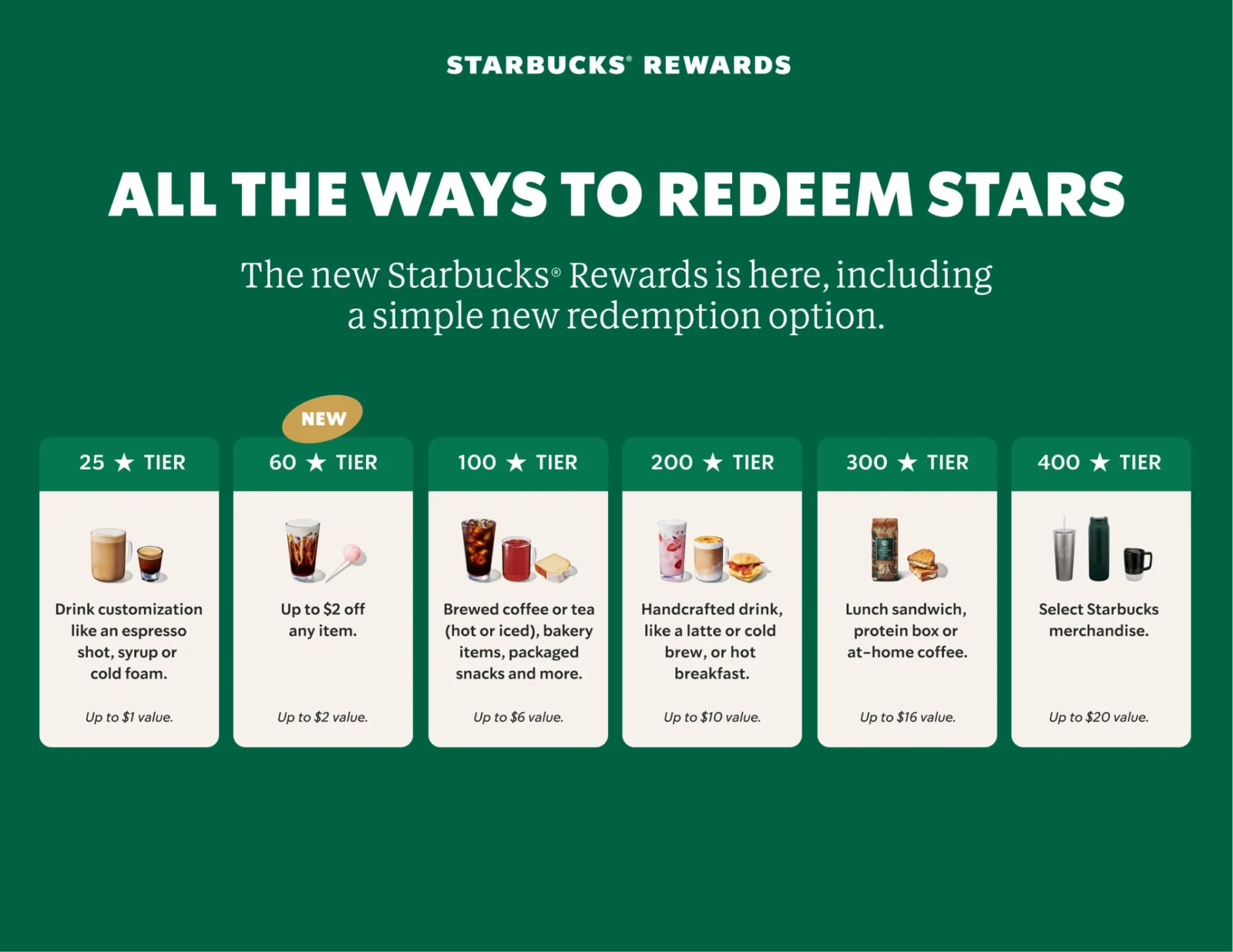
Divide each cap by the Stars it costs and a clear winner emerges.
The 100-Star tier is the best value in the program at roughly six cents per Star. The 200, 300, and 400 tiers all land around five cents. The 25-Star customization returns four.
And the new 60-Star coupon — the most flexible option, the one Starbucks added in response to member requests, the one promoted hardest — is the worst redemption on the menu at roughly 3.3 cents per Star.
Convenience costs you. The members most likely to grab the easy $2 off are giving up the most value per Star to get it.
If you take one habit from this piece, take that one: bank toward 100 and 200. Treat the 60-Star option as a convenience purchase, not a reward.
Who This Is Actually For
Reserve was never meant to be attainable. That’s the design, not a flaw in it.
Twenty-five hundred Stars a year works out to roughly $200 a month — someone who shows up several times a week, every week, without a lapse. For that person, the program is a genuine upgrade. Fastest earn rate in the category. Stars that never expire. Double Star Days that push the effective rate past three per dollar on the right mornings. And origin travel no competing coffee chain has attempted.
Gold is where the realistic math lives. Five hundred Stars is about $500 a year, or roughly ten dollars a week — which describes an enormous share of the membership.
The 20% earning bump is modest. The end of expiration is not. Expired Stars are the most common way loyalty value disappears without anyone noticing.
Green is where the cut lands hardest. Green is also most of the program.
None of this is unusual, or even especially cynical. A program that trims the average payout while building an aspirational ladder is just what tiered loyalty is.
What makes it consequential is the scale. Starbucks had 35.5 million ninety-day active U.S. members when the changes were announced, and 35.8 million by the quarter ending June 28 — against a real operating recovery, with North American comparable sales up 8.1% on a 4.5% rise in transactions and operating margin expanding 430 basis points to 14.4%.
Meanwhile, Across the Street
It’s worth pausing on how differently the competition is playing this, because the contrast explains Starbucks’ whole strategy better than any tier chart.
This summer belonged to a color.
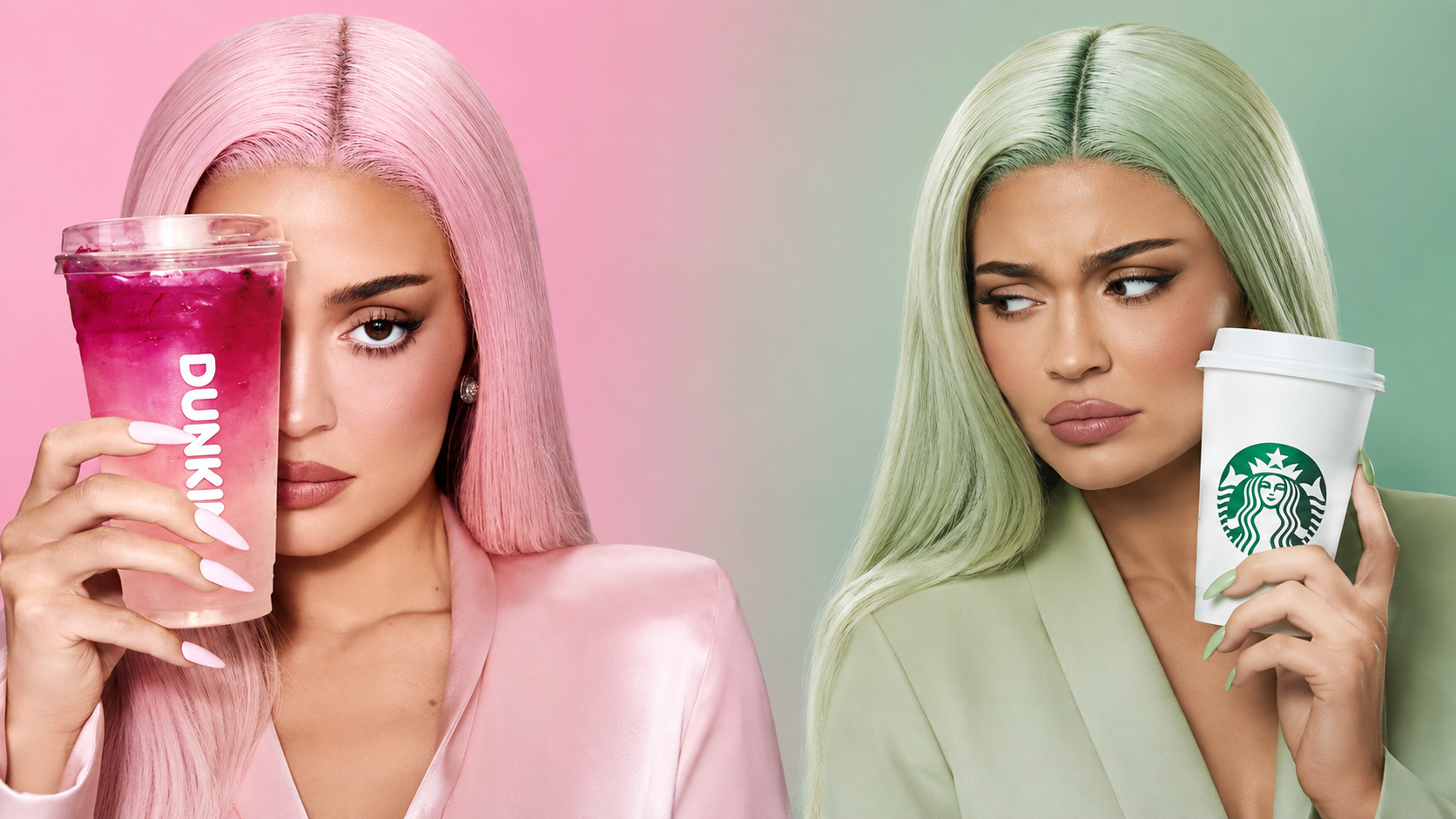
Dunkin’ rolled out a pink-saturated menu with Kylie Jenner, reviving her “King Kylie” era of neon wigs and 2010s streetwear. Starbucks answered with a summer lineup built around the Pink Drink, plus a nostalgia play of its own — the S’mores Frappuccino returning, and the Unicorn Frappuccino back for a single weekend in mid-August.
One analyst told the Boston Globe the two chains had built the same car and driven it into each other.
But the resemblance is only skin-deep, and what sits underneath it is the actual story.
Dunkin’s growth engine is star power, and they’re genuinely good at it. Ben Affleck is returning for a fourth Super Bowl spot. The DunKings. Ice Spice. A Sabrina Carpenter campaign whose teaser drew ten million views before the drink even existed, lifted app downloads 57%, and sold out $13 tumblers in seventeen minutes.
That is a masterclass in renting culture. It works.
Starbucks does almost none of it.
There’s no Starbucks equivalent of the DunKings. No pop star’s name on the menu board. No Super Bowl spectacle.
What Starbucks builds instead is infrastructure: baristas, service standards, more than a thousand renovated cafés, a rebuilt loyalty ladder, and linking deals with airline and hotel programs.
Dunkin’ buys attention, which is expensive and evaporates. Starbucks buys frequency, which compounds.
One strategy produces a cultural moment. The other produces 35.8 million people who open an app before they leave the house — and that, far more than any tier or Star rate, is what the March redesign was built to protect.
The Benefit Buried in the Last Line
Which brings us to the part of the announcement almost every guide has skipped entirely.
At the very bottom of Starbucks’ release, below the tiers and the redemption ladder, is a short line noting that members can link their Rewards account to select outside loyalty programs.
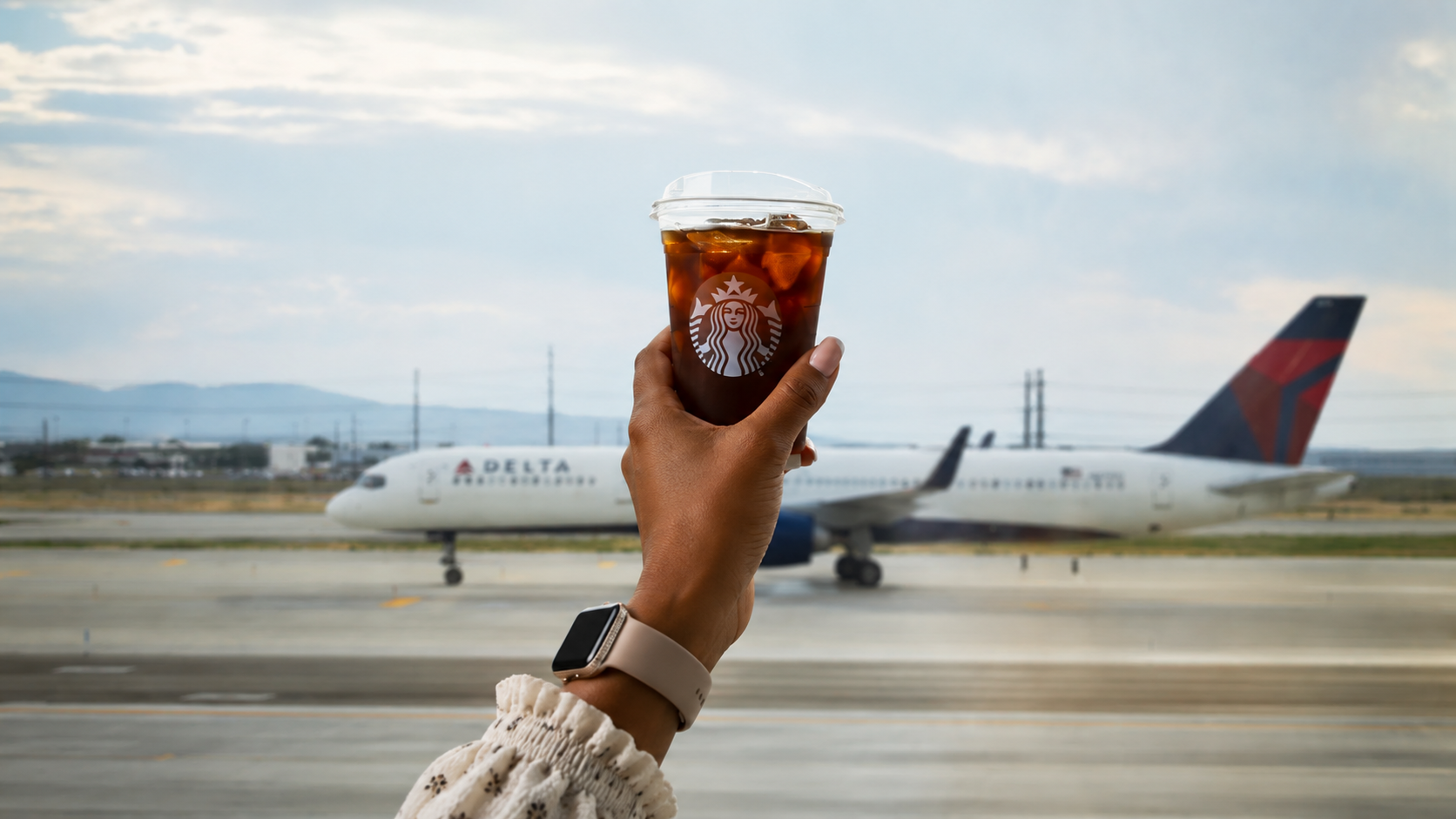
The two named partners: Delta SkyMiles and Marriott Bonvoy.
That single sentence changes the math more than any tier does. It means one coffee order can generate up to four separate currencies at once — Stars at your tier rate, airline miles, hotel points, and whatever your card returns on dining.
The Delta layer got simpler this month. As of August 5, 2026, linked members earn one SkyMile per eligible dollar spent at Starbucks again, replacing a reload-based structure that had governed the partnership for two years. Continued eligibility now requires a qualifying Delta flight within the previous twelve months. Double Stars on Delta travel days are unchanged.
Stack it at Gold, on a travel day, on a $10 order: 24 Stars, 10 SkyMiles, and 4x points on a strong dining card.
No single layer is impressive. Together, they’re the only version of this that justifies a moment’s thought.
That’s also the honest ceiling here, and it should be said plainly. Nobody’s coffee habit is funding a flight. No one should reorganize a morning around a 1.2 multiplier.
The value has never been in the chase. It’s in the overlap — which is exactly what Luxi, the LUXE AI concierge, is built to track: which programs, partners, and card benefits actually stack on a given purchase or reservation, so the math runs in the background and you just go where you were already going. The same logic applies at dinner: see where the Chase Sapphire Reserve dining credit actually works in Atlanta.
The tiers came back. The earning went down. And the advantage now belongs to whoever bothers to notice how the layers fit together.